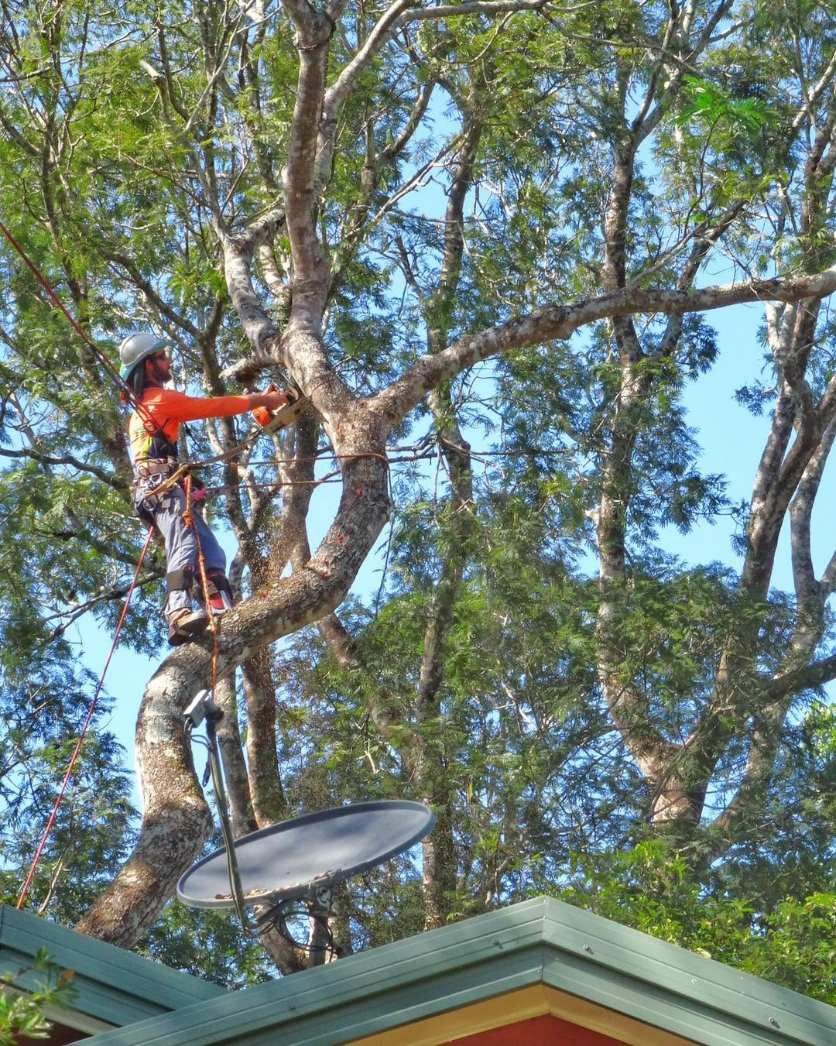
In Far North Queensland, warm weather and big wet seasons mean trees grow fast. Sooner or later, most homeowners look at a backyard tree and think it needs a lop. I have been an arborist for nearly 20 years and I hear the word every day. The name is not the problem. What matters is whether the tree is cut correctly.
The short answer
Professional pruning removes specific branches, at proper pruning points, for a clear reason. Clearing a roof, removing dead limbs or lifting a canopy over a driveway are all good reasons. Inappropriate lopping cuts indiscriminately, often to an arbitrary height, and leaves stubs behind.
| Professional pruning | Inappropriate lopping | |
|---|---|---|
| Where cuts are made | At the branch collar or a suitable growth point | Anywhere, often leaving stubs |
| Canopy kept | As much as the goal allows | Often removed heavily |
| Wound response | Supports the tree's natural defences | Large exposed wounds |
| Regrowth | Steady and well attached | Dense, fast and weakly attached |
| Long term | Less ongoing work | Repeat work and higher risk |
What heavy lopping does to a tree
- Stress. Taking off too much leaf limits the tree's ability to make energy and defend itself.
- Decay. Big cuts expose wood, and in our humid climate decay gets in fast.
- Weak regrowth. Heavy cuts trigger clusters of shoots that grow quickly but attach poorly.
- More cost. The tree looks smaller for a season, then needs work again.
- Permanent shape changes. Some trees never fully recover their form.
Why the position of the cut matters
Trees do not heal like skin. They wall off wounds inside the existing wood. A cut made just outside the branch collar works with that process. A long stub, or a cut flush against the trunk, works against it.
Common types of professional pruning
- Deadwooding: removing dead branches before they fall.
- Crown lifting: removing lower branches for clearance, without making the tree top heavy.
- Selective reduction: shortening chosen branches back to growth points.
- Crown thinning: removing selected interior branches, carefully, to manage density.
- Formative and corrective pruning: shaping young trees and fixing past bad cuts, sometimes over several visits.
Does pruning make a tree safer in cyclone season?
Pruning can deal with identified problems such as dead limbs, cracks and storm damage. No pruning makes a tree cyclone-proof, and blanket thinning can actually stress a tree. If you notice hanging branches, cracks, fungus, a new lean or lifting roots, get it looked at.
Is tree lopping illegal in Cairns?
Pruning on private property is not automatically prohibited. Some properties sit under vegetation, hillslope, landscape or landslip overlays, or have development conditions, and council's definition of damaging vegetation can include cutting. Check before you cut. If council needs it, a Level 5 arborist report supports your application, though council makes the final call.
The verdict
Call it lopping if you like. Just make sure whoever does the work starts with an assessment, has a clear goal, and cuts in the right place. That is the difference between a tree that thrives and one that becomes a problem.
Head Arborist, Coral Coast Tree Care. 19+ years in the trees around Cairns.